
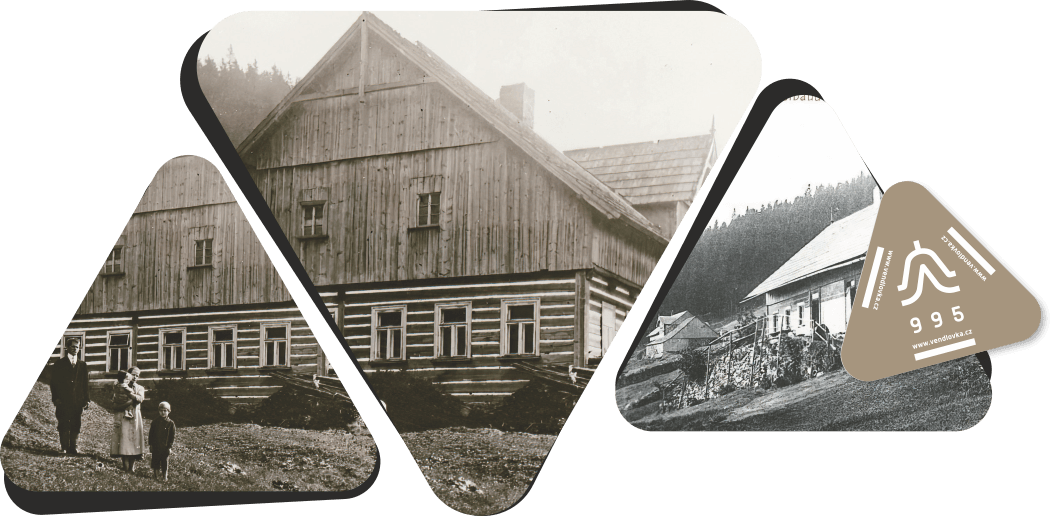
Vendlovka Lodge - Černá hora - Černý důl - Janské Lázně
The pristine spruce primeval forest, whose dark color gave the mountain its name (Black Mountain), perished during the second half of the 16th century. At that time, the property of the Bohemian Chamber was ruthlessly plundered by the owners of surrounding estates for the insatiable Kutná Hora mining district, where silver was mined, turning the spruce forest into extensive clear-cuts.
As early as 1609, a report from an inspection by mining officials offers a concise evaluation of most forest stands in the eastern Giant Mountains: "...the forests are now severely clear-cut and almost entirely deforested." It also contained criticism of the forest masters who permitted woodsmen to build huts in the mountains, keep livestock in them, drive them into the clearings, and create meadows and tilled plots around the huts.
After timber extraction ended, many Alpine colonists settled in the Giant Mountains permanently, and their temporary shelters in the newly created clearings laid the foundation for the settlement of several prominent meadow enclaves on the slopes of Černá hora.
Farmers from Velká Úpa, in particular, first established summer huts on distant haymaking grounds, where they drove their cattle during the season. This is likely how Volské Boudy originated as early as the late 17th century; Zinneckerovy Boudy were documented in 1720, and ten years later, Velké Kühnelovy Boudy, which were renamed Pardubické Boudy in 1945.
The large quantity of cleared stones piled into rock ridges (called "hrobky") around Zrcadlovka and Vendlovka also testifies to long-term farming on the extensive meadow along the municipal boundary of the former villages of Černá Hora and Černý Důl.
Other mysterious earthworks of human origin, whose precise beginnings remain unexplained, trace back to the Thirty Years' War under the name "Swedish Redoubts" (Švédské šance). Findings by amateur archaeologists led by Berthold Aichelburg in the mid-19th century supported theories of raids by Tatar warriors in the 13th century. More pragmatic researchers suggest encampments of Prussian troops during the Potato War of 1778. Oral tradition long preserved a legend about the site being settled by Lusatian Sorbs under the protection of King Gustavus Adolphus of Sweden.
Today, few would guess that the familiar name of one of the huts – Vendlovka – originates from the former house of the Lusatian Sorbs (Wendenhaus - Inverted/Turned House).
After 1785, the first hut in the group of chalets at Černá paseka was built. Most were simple timber-framed wooden structures with gabled roofs, or in better cases, featuring a roof dormer facing uphill. Vendlovka originally had its dormer facing downhill, as seen in period photographs from Zrcadlovka. The entrance to the ground floor, which consisted of one large main room and a stable separated by a hallway, was from a paved stone porch. The roof ridge followed the terrain contour lines.
The individual meadow enclaves were significantly larger than they are today. In the mid-19th century, the Volské Boudy settlement alone covered an area five times larger than the current surroundings of Horský hotel and Sokolská bouda. Tourism began to flourish, especially scenic walks offering breathtaking views of the countryside. One of the finest, crowned by unforgettable sunrises, is from Černá paseka. It is no wonder that Robert Bönsch, an enterprising innkeeper from the U Slunce Hotel in Velká Úpa whose brothers already owned Luční bouda at the time, bought an old lodge from Wenzel Sagasser of Javoří Důl and opened a mountain restaurant here in 1888 – Bouda na Černé pasece, later known as Černá bouda.
While the farmers from Zinneckerovy Boudy or Zrcadlovka remained content for a long time with adding a glass veranda and a temporary dormitory – and even at the turn of the 20th century considered simple cutlery an unnecessary luxury – the Bönsch family continually invested in expanding and enhancing their services. At a key lookout point, they added a tower with a panoramic mirror and telescope, maintained a toboggan run, and earned a reputation for excellent cuisine.
In 1925, his son Karel Bönsch bought Zrcadlovka, and a major hospitality establishment emerged in every group of huts owned by the family, with the exception of Malé Pardubické Boudy, which remained untouched by tourism until 1945.
With the construction of the first passenger aerial cableway in Czechoslovakia from Janské Lázně to Černá hora in 1928, visitor numbers multiplied, attracting investors with external capital to the summit. Most notably, the Czechoslovak Sokol Organization built the stylish four-story timbered Sokolská bouda on forest land leased from Count Czernin-Morzin at Volské Boudy, which had previously been off the main tourist paths. Its first tenant, Jan Černý from the Eagle Mountains, after five successful seasons, built the grand Horský Hotel on the site of the lower Volská Bouda No. 45. Its preserved presidential suite hosted both presidents of the First Czechoslovak Republic on several occasions.
Robert Bönsch's heirs were equally proactive and began constructing the fully modern new Černá bouda even before the cableway was completed.
Publication of these texts with the kind permission of Mr. Antonín Tichý,author of www.freiheit.cz